Residential electrical work in Lake Charles
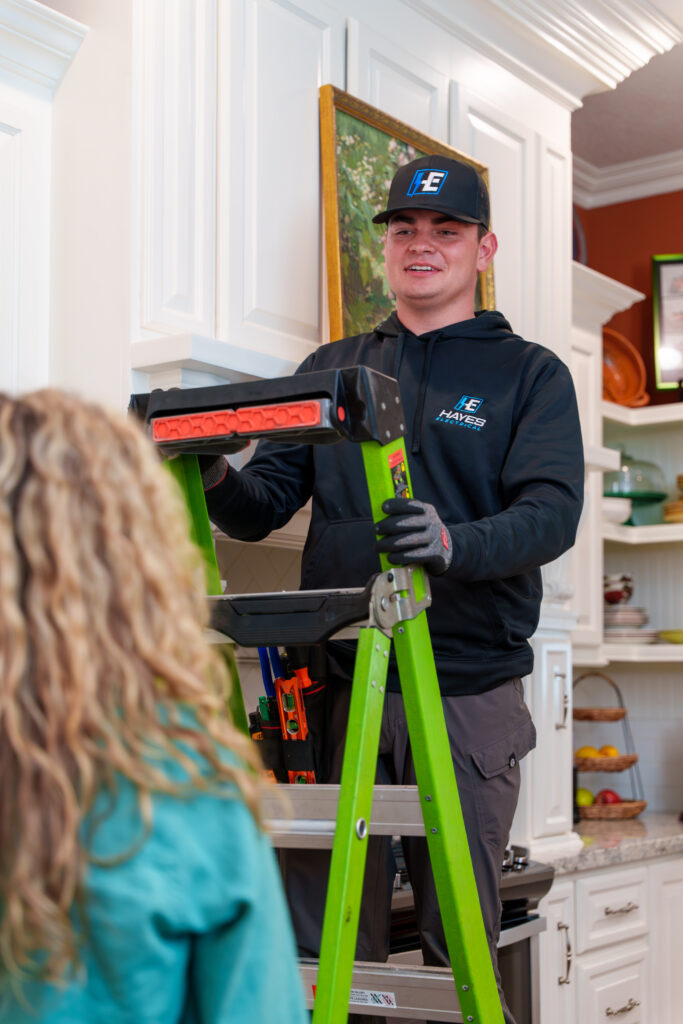
We work on houses. From the meter base in, every wire, every device, every fixture. New construction, additions, remodels, repairs, code-correction work, panel upgrades, generator installs, EV chargers, and the day-after-Christmas service calls when something popped overnight. Most days we are in a Lake Charles neighborhood, on a ladder or in an attic, fixing or building something that has to outlast the next named hurricane.
What we do on residential
New construction and major remodels
We rough in branch circuits, run feeders to detached buildings, install panels, set the meter, and trim out devices after sheetrock and paint. We work from the architect or designer plan when there is one, and we draw the plan ourselves when there is not. Branch circuit count follows NEC 210.11: minimum two small-appliance circuits in the kitchen, dedicated bath circuit, dedicated laundry, and the general lighting load by square footage.
Older home rewires
Charpentier Historic District, Margaret Place, and the downtown blocks are full of houses built before the modern electrical code. The original wiring was knob-and-tube, which works fine in open air but is a fire risk once buried in blown-in insulation. We do whole-house rewires that preserve the trim work and the plaster as much as possible, fishing new 12 and 14 AWG NM cable through the existing wall cavities and adding boxes where the original installer never thought there would be one. Permits, inspections, and historic-district review when applicable.
Service and panel upgrades
The 100A service was standard in the 1960s and 70s. With central AC, electric dryer, electric range, and now EV charging, 100A is no longer enough. We upgrade to 200A or 400A depending on the load calc per NEC 220. Service upgrade includes the meter base, the service-entrance conductors, the main panel, and the grounding electrode system. We coordinate the disconnect and reconnect with Entergy and pull the permit with the city or parish.
AFCI and GFCI compliance
Current code (NEC 210.8) requires GFCI protection on receptacles in bathrooms, kitchens, garages, outdoor, laundry, and within 6ft of any sink. NEC 210.12 requires AFCI protection on most living-area circuits. On older homes the AHJ does not retroactively require GFCI/AFCI on existing circuits, but when we open a circuit for repair or extension we bring it up to current code. On insurance-driven repair lists, GFCI and AFCI retrofits are common.
Lighting, fixtures, and fans
Recessed cans, can-light retrofits to LED, pendant fixtures, ceiling fans (verify box rating per NEC 314.27), exterior lighting, soffit lights, dock lights for waterfront homes, and landscape lighting. Recessed cans in insulated ceilings need IC-rated housings per NEC 410.137. Wet-location fixtures (covered porches, under eaves) need the wet-rated marking.
Pool, spa, and waterfront
Pool and spa wiring follows NEC 680, including equipotential bonding per NEC 680.26 with a #8 solid copper grid around the perimeter. Pool pump receptacles need GFCI protection. Underwater lights need transformer isolation. Dock receptacles for waterfront homes on Lake Charles or Calcasieu River follow NEC 555 marina rules where applicable, and we use marine-grade hardware for the salt humid air.
Older Lake Charles housing stock
If you live in a home built before 1975, expect one or more of these to be present: knob-and-tube, two-prong ungrounded receptacles, aluminum branch wiring (1965-1973), undersized service (60A or 100A), Federal Pacific or Zinsco panel, ungrounded boxes, no AFCI, no GFCI, no surge protection. None of these has to come out at once, but they should be on a plan. Insurance carriers are starting to flag aluminum branch wiring and Federal Pacific panels on policy renewal in Louisiana.