Low voltage and network wiring in Lake Charles
Low voltage is everything under 50V: data network, phone, security camera, doorbell, intercom, audio, access control, thermostat wiring, and similar systems. We do structured wiring on new construction, retrofit Cat6 to existing homes and offices, install fiber for longer runs, and install POE camera systems and access points. Low voltage cabling falls under NEC 800 (communications) and NEC 770 (fiber) and the work is regulated, particularly in commercial settings.
Network and data wiring
Cat6 standard, Cat6A for higher demand
Cat6 is the standard residential and small commercial network cable. It supports 1Gbps to 100 meters (about 328 feet) and 10Gbps to 55 meters. Cat6A supports 10Gbps to the full 100 meters. We use Cat6 for most residential installs because 1Gbps is more than enough for most homes. Cat6A goes in for offices, server rooms, and homes where the owner wants 10Gbps to specific locations (gaming setup, home theater, server rack).
Run length limits
The 100-meter limit applies to the total run length from the switch to the device. On longer runs we either install an intermediate switch or run fiber. The 100-meter limit is not arbitrary, it is the maximum distance Cat6 maintains signal quality at full bandwidth. Exceeding the limit causes packet loss and intermittent connection failures.
POE, POE+, POE++
Power over Ethernet delivers DC power on the same Cat6 cable as the data. POE (802.3af) delivers 15W. POE+ (802.3at) delivers 30W. POE++ (802.3bt) delivers 60W or 90W depending on the type. We size the POE switch to the connected devices. A typical security camera draws 5-12W. An indoor AP draws 10-25W. An outdoor AP or PTZ camera can draw 30-60W.
Patch panels, racks, and dressing
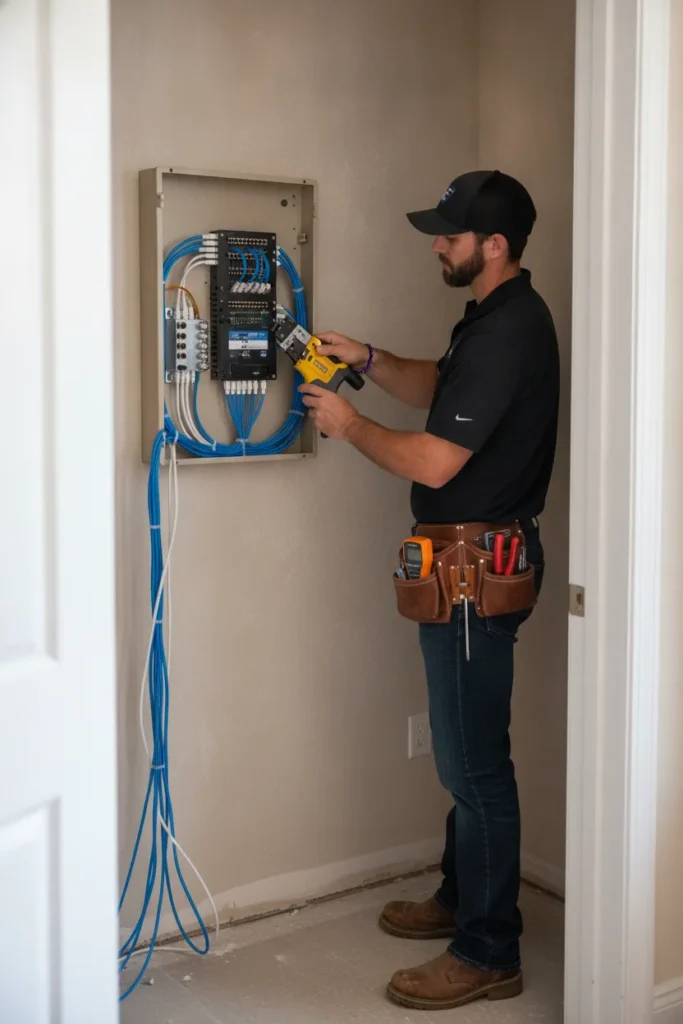
For commercial and structured residential we terminate cables at a patch panel in a wall-mount or floor rack. Each cable gets a label at both ends. The patch panel side gets dressed cleanly with horizontal cable managers. The closet stays organized so the next time someone needs to add or change a cable, it takes minutes not hours.
Fiber optic
Fiber is required when the run exceeds Cat6 length limits (100m for 1Gbps, 55m for 10Gbps) or when the building requires fiber for electromagnetic isolation. We install single-mode for long runs and multi-mode for short building backbones. Fiber pulling is delicate (minimum bend radius matters) and termination is either field-fused or pre-terminated patch cables. We typically run multi-strand fiber on backbones for future capacity.
Security cameras and access points
IP cameras (POE)
We install Ubiquiti, Hikvision, Axis, and similar IP camera systems on POE switches. Each camera runs back to the switch on a single Cat6 cable that carries both data and power. The NVR (network video recorder) stores the footage and runs the camera management software. We mount cameras on dedicated junction boxes (NEMA 4 outdoor, NEMA 1 indoor) at the cable entry point so the cable does not enter the camera housing exposed.
Wireless access points
For homes and offices with weak Wi-Fi coverage, we install POE access points (Ubiquiti UniFi, Aruba Instant, Cisco Meraki) on ceiling-mounted plates wired back to a central switch. Properly designed Wi-Fi uses multiple APs at lower power rather than one strong AP, which improves coverage and reduces interference. We do a site survey for larger installs to pick the AP locations.
Wireless access control and intercoms
Doorbell cameras (Ring, Nest, Eufy), video intercoms, and access control panels. Doorbell cameras can run on existing doorbell transformer power if it is 16V or higher. Older homes often have 8V transformers and we upgrade the transformer to 24V for current-gen video doorbells. Access control panels (proximity readers, keypad locks, mag locks) require dedicated low-voltage runs and battery backup.
Other low-voltage work
Audio cabling for whole-house audio, thermostat wiring for HVAC zones, garage door opener wiring, gate operator wiring, doorbell rewiring on remodels, irrigation controller wiring, and pool/spa equipment communication wiring. We pull every cable to the same standard (labeled both ends, terminated to spec, tested under load) regardless of the application.