Surge protection and grounding in Lake Charles
Lightning hits Louisiana more than most states. Calcasieu Parish averages high storm activity from May through October, and named hurricane systems drag massive surge events through the grid even when the storm itself is hundreds of miles away. After Laura and Delta in 2020, the count of fried HVAC controls, dead refrigerators, and bricked electronics was high enough that whole-house surge protection moved from “nice upgrade” to “obvious investment” for most homeowners.
Surge protection and grounding are related but distinct topics. Grounding is the path that fault current and surge energy follows to earth. Surge protection devices (SPDs) are the components that clamp the voltage during a surge event and divert energy to ground. Both need to be done correctly for either to work.
Whole-house surge protection
Type 1, Type 2, Type 3
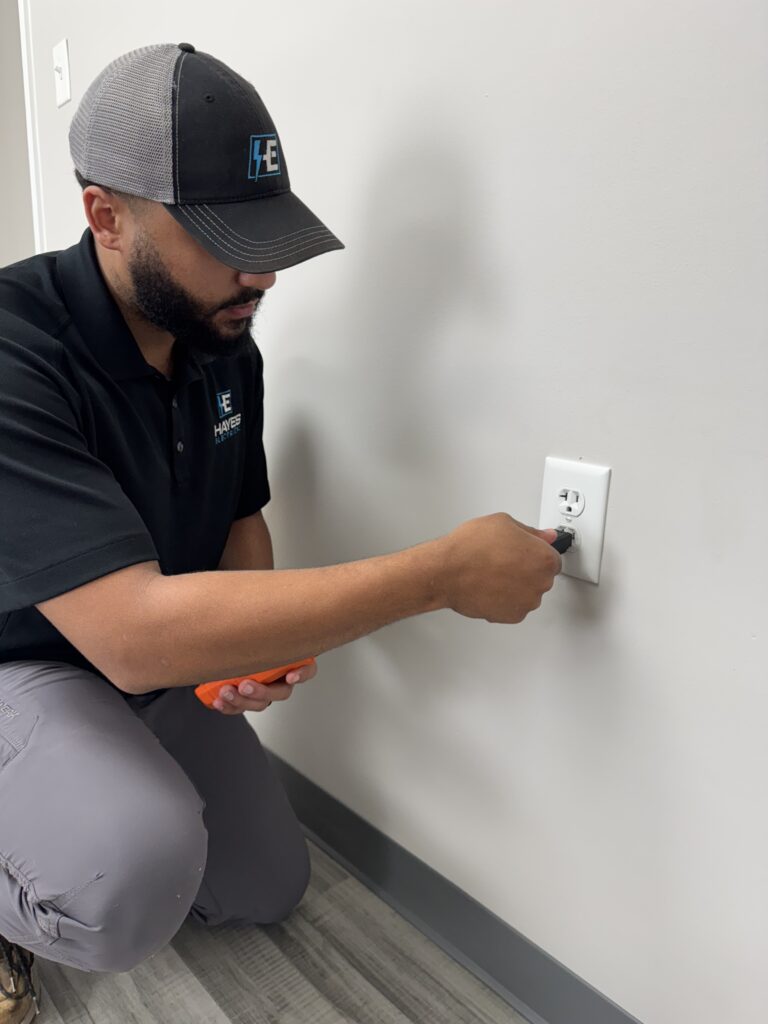
NEC 285 and the UL 1449 standard classify surge protective devices by where they install. Type 1 SPDs install on the line side of the main breaker (between the utility and the main). Type 2 SPDs install on the load side of the main breaker (in the panel itself, on a 2-pole breaker). Type 3 SPDs are point-of-use (the strip plugged into the wall behind your TV).
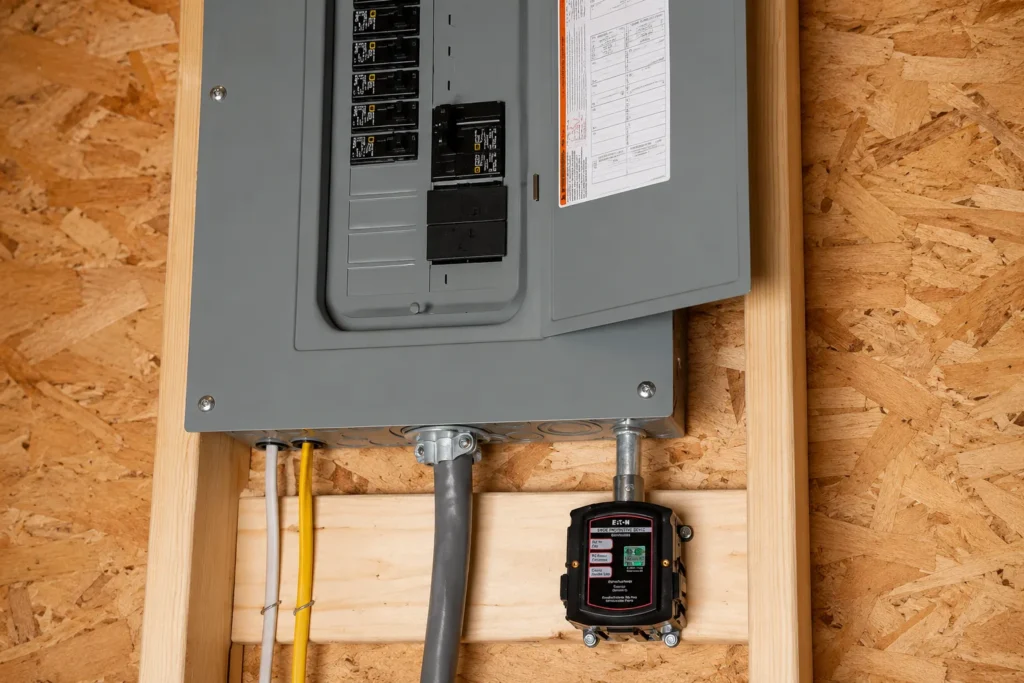
A Type 2 SPD at the main panel is the standard whole-house install. It clamps surge voltage at the panel before the surge reaches branch circuits. NEC 230.67 (added in the 2020 code cycle) now requires SPD on all new and replacement residential services, and the requirement is being adopted by Louisiana AHJs as the local code updates roll out.
What an SPD will and will not do
An SPD will absorb the millisecond-scale surge events that come through the grid from lightning hitting nearby, switching transients from utility equipment, and surges from large motor loads (your AC compressor cycling). It will reduce the surge voltage that reaches your branch circuits from thousands of volts to a few hundred volts.
An SPD will not stop a direct lightning strike on the house. A direct strike is too much energy for any residential SPD. A whole-house surge protection plan should include the Type 2 SPD at the panel plus Type 3 strips at sensitive electronics (TVs, computers, audio gear, refrigerators with electronic controls) for layered protection.
Replacement and warranty
SPDs are sacrificial. They absorb energy until they reach end of life, then they need replacement. Most quality SPDs include an indicator light or a relay output that signals when the device has reached end of life. We check the SPD on every panel visit. Most quality residential SPDs (Eaton CHSPT2ULTRA, Square D HEPD80, Siemens FS140, Leviton 51120-1) carry connected-equipment warranties from the manufacturer.
Grounding system
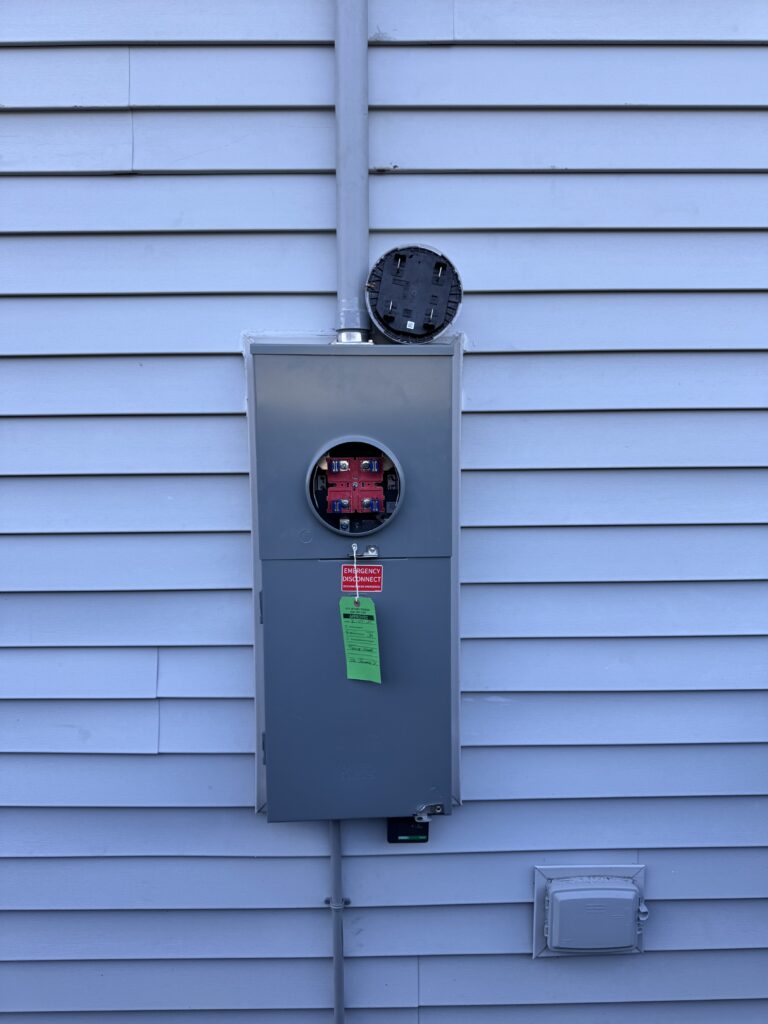
Grounding electrode system per NEC 250
Every service needs a grounding electrode system. The electrodes are: ground rods (NEC 250.52 lists multiple acceptable types, but ground rods are most common), buried metal water pipe, structural steel, concrete-encased electrode (Ufer ground if available), and others. Most Lake Charles residential services use 8-foot copper-clad ground rods.
25-ohm rule and supplemental electrodes
NEC 250.53 requires that a single ground rod test under 25 ohms to earth, or that a supplemental electrode (a second rod) be installed at least 6 feet from the first. In practice, single ground rods in Louisiana soil rarely test below 25 ohms because the soil moisture is high but the resistivity varies. We typically install two rods on every new service install as standard practice, which makes the 25-ohm question moot.
Main bonding jumper (MBJ)
The MBJ connects the neutral bar to the equipment grounding conductor bar at the service equipment. NEC 250 requires the MBJ at the service, and ONLY at the service. Sub-panels do NOT have an MBJ. The neutral and ground bars are isolated at every sub-panel. This is one of the most common code violations we find on older homes where someone added a sub-panel and bonded the neutral to ground at the sub-panel instead of leaving it isolated.
Grounding electrode conductor (GEC)
The GEC runs from the grounding electrode (ground rod) to the service neutral bar. Sized per NEC 250.66 based on the service conductor size. For 200A residential the GEC is typically 4 AWG copper. The GEC must be continuous (no splices) or spliced only with listed irreversible connectors.
Equipment bonding
NEC 250 requires bonding of metal water pipes (within 5 feet of where the pipe enters the building), metal gas pipes, and structural steel where present. The bonding makes sure these systems do not become energized during a fault. We add bonds where they are missing on older homes.
Pool, spa, and equipotential bonding
Pool and spa wiring follows NEC 680 and requires equipotential bonding per NEC 680.26. The bond is a #8 solid copper grid around the pool, connected to the pump motor, the rebar, ladders, and any metal within 5 feet of the water. The point is to ensure that everything around the pool is at the same potential, so a person standing on the deck and touching the water does not become the path between two different ground potentials. Missing or incomplete equipotential bonding is one of the most common pool wiring violations we find.